

Why Modern Product Manufacturers Need Product Data Exchange
Inside This Article

Modern product development has never been more complex. Engineering teams are expected to move faster, manage increasing product complexity, and collaborate across globally distributed partners—all while navigating supply chain volatility, regulatory pressure, and tighter margins. Yet, despite these demands, many organizations still rely on outdated, manual methods to exchange critical product data with internal teams and external partners.
In a market defined by disruption and acceleration, the absence of a structured product data exchange (PDX) strategy creates unnecessary friction and risk. File sharing, spreadsheets, and email-based collaboration may feel familiar, but they introduce hidden costs that compound as products scale. Engineering collaboration improves when product data moves seamlessly between teams instead of through spreadsheets and email. Explore how connected engineering collaboration helps accelerate product development. Understanding both the challenges of operating without PDX and the benefits of adopting it has become essential for modern manufacturers.
What Is Product Data Exchange (PDX)?
Product data exchange is an industry-standard format designed to package, share, and review complete product definitions across systems and supply chain partners. Based on an XML structure developed by NEMI, PDX enables organizations to exchange bills of materials (BOMs), approved manufacturer lists (AMLs), approved vendor lists (AVLs), engineering change orders (ECOs), documentation, drawings, and related relational data in a single, structured package.
Unlike spreadsheets or static PDFs, a PDX package preserves the context and relationships within the product record. This ensures that downstream partners and ERP systems receive accurate, consumable data without manual reformatting or interpretation. In essence, PDX serves as a common language across the extended product ecosystem.
The Risks of Operating Without Product Data Exchange
Organizations that lack a formal PDX solution often encounter challenges that slow development and increase risk. While these issues may appear manageable in isolation, they quickly escalate as product complexity and supplier networks grow.
Lack of Version Control
One of the most common risks is version confusion. Manually exported BOMs and documents become outdated almost immediately, leading to uncertainty about which revision is authoritative. Suppliers may inadvertently build from incorrect data, resulting in scrap, rework, or production delays.
Time-Consuming Manual Sharing
Manual effort is another significant burden. Engineering and document control teams spend countless hours assembling build packages, converting files, and explaining data structures to suppliers. These repetitive tasks divert resources away from higher-value activities such as design optimization and risk mitigation.
Decreased Traceability
Limited traceability further compounds the problem. When product data is exchanged through email and shared drives, it becomes difficult to track what information was sent, when it was sent, and who received it. This lack of visibility complicates audits, investigations, and change management.
Supplier Misalignment
When product data is shared through email, spreadsheets, and static files, suppliers are more likely to receive incomplete, outdated, or disconnected information. This lack of a consistent, structured exchange increases the risk of misinterpretation and slows collaboration during design reviews, manufacturing handoffs, and production ramp, especially as supply chains grow more complex.
Increased Supply Chain Disruptions
Most critically, operating without PDX increases exposure to supply chain disruptions. Without structured, standardized data exchange, organizations struggle to respond quickly to component shortages, compliance changes, or geopolitical events. In today’s volatile environment, that lack of agility can be costly.
The Benefits of Product Data Exchange
PDX addresses these challenges by providing a controlled, repeatable method for sharing complete product definitions while preserving context and traceability. At an organizational level, PDX delivers several strategic benefits:
- Accelerated collaboration: Teams can generate clean, consistent build packages directly from their system of record, eliminating manual reformatting and reducing back-and-forth communication.
- Improved product record confidence: Both internal and external stakeholders work from the same snapshot of approved data, reducing version confusion and errors.
- Strengthened change management: Engineering changes can be communicated clearly and consistently, with full visibility into what has changed and why.
- Reduced operational risk: PDX lowers operational risk by improving transparency and accountability across the supply chain.
Role-Based Benefits of PDX
The value of PDX becomes even clearer when viewed through the lens of specific roles within the organization.
For engineering teams, PDX preserves BOM structure, relationships, and design intent. Engineers can spend less time answering clarification questions and more time innovating.
For operations and manufacturing teams, standardized build packages reduce ambiguity and help prevent production errors. Clear, consistent data supports smoother handoffs from design to manufacturing.
For supply chain and sourcing professionals, PDX enables faster supplier onboarding, clearer request for quotes (RFQs), and more agile responses to component volatility. Structured data exchange supports multisourcing strategies and earlier risk identification.
For quality and compliance leaders, PDX supports traceability, audit readiness, and proactive risk management. Complete product definitions are easier to review, validate, and document.
Arena Exchange: Purpose-Built PDX for Modern Supply Chains
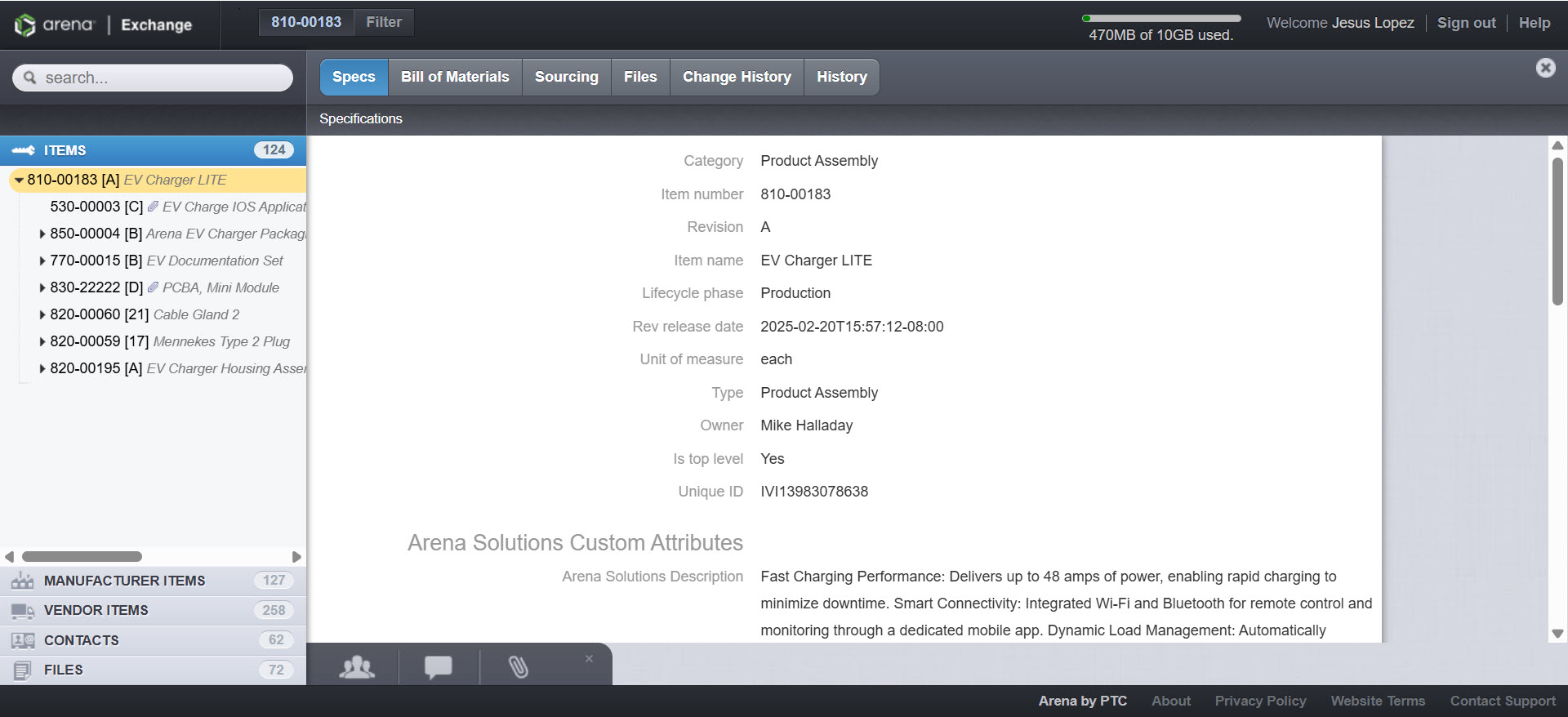
Arena Exchange extends the power of PDX by providing a secure, cloud-based collaboration environment designed specifically for complex supply chains. Rather than distributing files through email or granting full system access, Arena Exchange allows organizations to invite partners to collaborate around a specific design or build package.
With Arena Exchange, partners can securely view, comment on, and download the latest BOMs, documents, AMLs, and AVLs—all within the context of the product record. In-context commenting ensures discussions remain tied to specific items and changes, improving clarity and accountability.
Arena Exchange removes traditional barriers to collaboration by eliminating licensing and training requirements for suppliers. Organizations can scale collaboration across direct and indirect partners without increasing administrative overhead. Access is secure, auditable, and easy to manage.
These capabilities are especially valuable amid today’s supply chain volatility. As manufacturers contend with component shortages, geopolitical disruption, and regulatory change, Arena Exchange enables earlier communication, faster issue resolution, and greater resilience.
Why PDX Matters More Than Ever
As manufacturers look ahead, several product development trends underscore the growing importance of PDX. Digital transformation continues to accelerate, yet many organizations still operate with uneven digital maturity. Supply chains are becoming more localized and diversified, increasing the need for consistent data exchange. Regulatory complexity is rising across industries, placing greater emphasis on traceability and compliance.
PDX solutions address these challenges by replacing fragile, manual processes with standardized, traceable data exchange. By enabling real-time collaboration and preserving product context across organizational boundaries, PDX supports faster innovation, lower risk, and greater resilience.
Product data exchange is no longer optional. It is a foundational capability for manufacturers seeking to scale efficiently, collaborate confidently, and compete effectively.
 Arena Marketing