

Staying Audit Ready in MedTech: Practical Advice From Arena Expert Jae Park
Inside This Article

Medical device manufacturers operate in one of the world’s most heavily regulated industries. Whether preparing for an FDA inspection, pursuing ISO 13485 certification, or managing compliance across global markets, organizations need accurate documentation, full traceability, and confidence that their quality processes can withstand scrutiny.
To explore what audit readiness looks like in practice, we interviewed Jae Park, an Arena Customer Success Coach with extensive experience building and managing quality systems for leading MedTech companies. In this blog, she shares insights on compliance, audit preparation, and why an integrated cloud product lifecycle management (PLM) and quality management system (QMS) solution is essential for commercialization success.
Jae, please tell us about your professional background.
Jae: My background is in medical device quality. I’ve worked with a wide range of products, including hardware, software, and integrated systems, spanning Class I through Class III implantable devices.
For several years, I built quality systems from the ground up and supported organizations through ISO certification efforts. Before joining PTC, I served as the Arena PLM and QMS administrator at a medical device startup that developed brain-computer interface technology.
Describe your experience using cloud-native PLM and QMS as a former Arena customer.
Jae: I joined my previous company shortly after its Arena PLM and QMS implementation. The timing worked out perfectly because the organization was building its quality system while adopting Arena. As we developed processes, we configured them directly in the system. That made implementation much smoother and helped ensure alignment between our procedures and daily workflows.
As the company grew, Arena continued to deliver new capabilities, including attribute groups and automations. For a small team with limited resources, those features were equivalent to adding additional staff. The system automated many repetitive tasks, allowing our team to focus on more strategic work.
For medical device companies, connected PLM and QMS also strengthen change control by linking engineering changes, quality processes, approvals, and product records within the same controlled environment.
Over time, I became a strong advocate for Arena after seeing how it streamlined quality and compliance management. That experience ultimately led me to join Arena as a customer success coach.
Why is it important for medical device companies to have both PLM and QMS working together?
Jae: I find it a little unusual when people talk about PLM and QMS as separate systems. For medical device companies, they’re deeply connected. You really can’t have an effective quality management system without strong product lifecycle management.
Your PLM environment manages revision control, approvals, documentation history, and change tracking. These capabilities are essential compliance requirements within a regulated quality management system. Product lifecycle and quality management are not separate activities. Instead, they operate in tandem, creating a unified framework for compliance.
The industry is also moving toward greater process integration. Auditors want to understand how complaints, nonconformances, corrective and preventive actions (CAPAs), engineering changes, and product records relate to one another. An integrated Cloud PLM and QMS environment makes these relationships visible and traceable. Teams can trace issues to their source, assess risk, and easily demonstrate how actions affect products and processes.
What do organizations often underestimate about managing compliance?
Jae: One common misconception is that compliance is a one-time project. Companies sometimes believe they’ll establish a quality system, pass an audit, and then be finished.
In reality, compliance evolves continuously. Regulations change, organizations expand into new markets, products mature, and risk profiles shift. Quality systems need to evolve alongside these changes.
Organizations benefit from regularly reviewing their processes and verifying that procedures align with current business needs, products, and regulatory requirements. Ongoing evaluation helps maintain compliance and strengthens operational performance.
A great example is the FDA’s transition from the Quality System Regulation (QSR) to the Quality Management System Regulation (QMSR), which aligns more closely with ISO 13485. Companies with adaptable systems can respond efficiently to new requirements and maintain alignment with evolving standards.
What areas tend to be most challenging during regulatory audits?
Jae: CAPA management is one of the biggest challenges. Many companies struggle to understand what a complete CAPA record should include and how to document the process effectively. It’s an area that frequently receives attention during FDA inspections.
At one of my previous companies, we configured our CAPA process using Arena’s quality workflows and Project Management capabilities. Through project implementations, we created a clear record of corrective actions, including ownership, timelines, and completion statuses.
An auditor reviewed the process and was impressed by how the system created a clear, traceable story that was easy to follow. Ultimately, they recommended that we incorporate that structure more broadly across our procedures.
Training documentation is another major focus. Auditors frequently ask organizations to demonstrate that employees were properly trained on updated procedures, changes, or quality processes. The ability to retrieve training records immediately is critical during an audit. Arena’s connected Training Management solution addresses this need by providing centralized access to the latest employee training plans and materials.
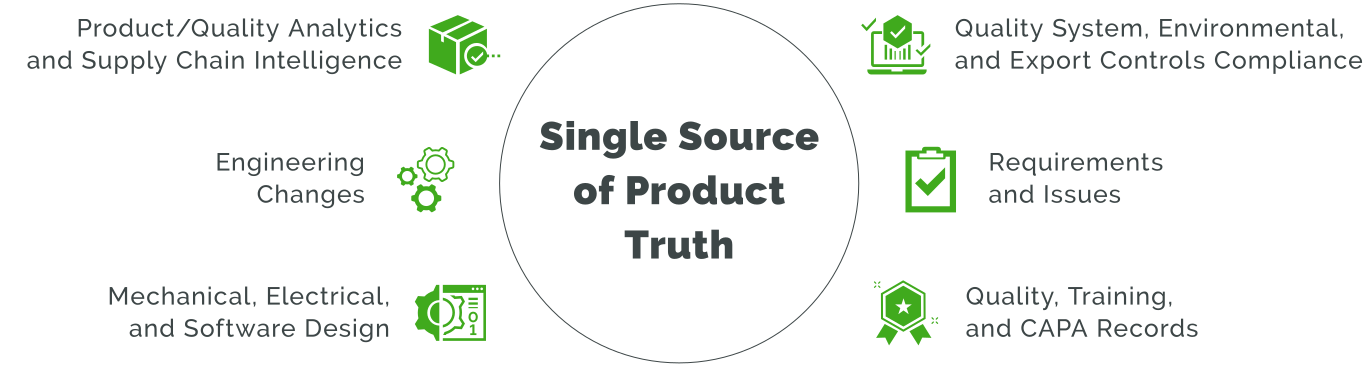
How does a single source of truth help streamline audits?
Jae: Audits require a significant investment of time, money, and resources. When information is scattered across multiple systems, people waste valuable time searching for records or verifying which version is correct.
A single source of truth ensures consistency. Everyone works from the same information, reducing the risk of conflicting explanations or inaccurate documentation.
Centralized, searchable information also speeds up the audit process dramatically. Instead of spending 15 or 30 minutes locating a training record or change history, you can retrieve it immediately with a cloud-native PLM and QMS solution like Arena. The faster you respond to requests, the more confidence auditors have in your quality system.
In my experience, audits consistently finished ahead of schedule because we could quickly provide documentation, demonstrate traceability, and answer questions confidently.
What advice would you give companies trying to build an audit-ready culture?
Jae: I would offer these three tips:
1. Think about your quality system holistically. Build processes that reflect how your teams work rather than forcing people to adopt entirely new ways of operating. Small, practical improvements often yield better compliance outcomes than massive procedural changes.
2. Make compliance easy. The easier it is for people to do the right thing, the more consistently they’ll do it. Features like embedded guidance, help text, configurable forms, and workflow automation reduce confusion and minimize errors.
One of my favorite sayings is that compliance happens in the forms people complete every day. The records created through daily work are what auditors ultimately evaluate. Making those workflows straightforward and intuitive has a huge impact on audit readiness.
3. Ensure information is easy to find. My personal rule was that if I couldn’t find a document in two clicks, something needed to change. A quality system shouldn’t become a document repository where information disappears. Searchability and accessibility are just as important as document creation.
Which Arena capabilities have the biggest impact on compliance and audit readiness?
Jae: Two capabilities stand out to me: attribute groups and automations. Together, they help organizations simplify complex processes, reduce manual effort, and guide users through compliant workflows.
Arena’s attribute groups streamline form completion, eliminate unnecessary fields, and create more intuitive user experiences. Arena Automations enforces process requirements, populates due dates, triggers actions, and ensures consistency without requiring employees to memorize steps.
The goal is to make compliance part of everyday work rather than an added burden. When compliance is built directly into workflows, teams spend less time managing documentation and more time focusing on innovation.
Audit Readiness Starts With Connected Processes
For medical device companies, audit readiness is about creating connected processes that support product development, quality management, and regulatory compliance at every stage of the lifecycle. With regulations continuing to evolve, and auditors placing greater emphasis on traceability and risk management, organizations need a connected system to meet these demands.
As Jae Park notes, a unified Cloud PLM and QMS environment enables teams to maintain accurate records, simplify compliance activities, and improve audit responsiveness. With greater visibility and control across quality processes, organizations can cultivate a culture of continuous compliance and accelerate the delivery of safe and effective products.
Discover how Arena builds audit readiness into every stage of the product lifecycle. Learn more.
 Shelly St.Hill