
What Is the Best Way to Migrate From Agile PLM to Arena?
Inside This Article
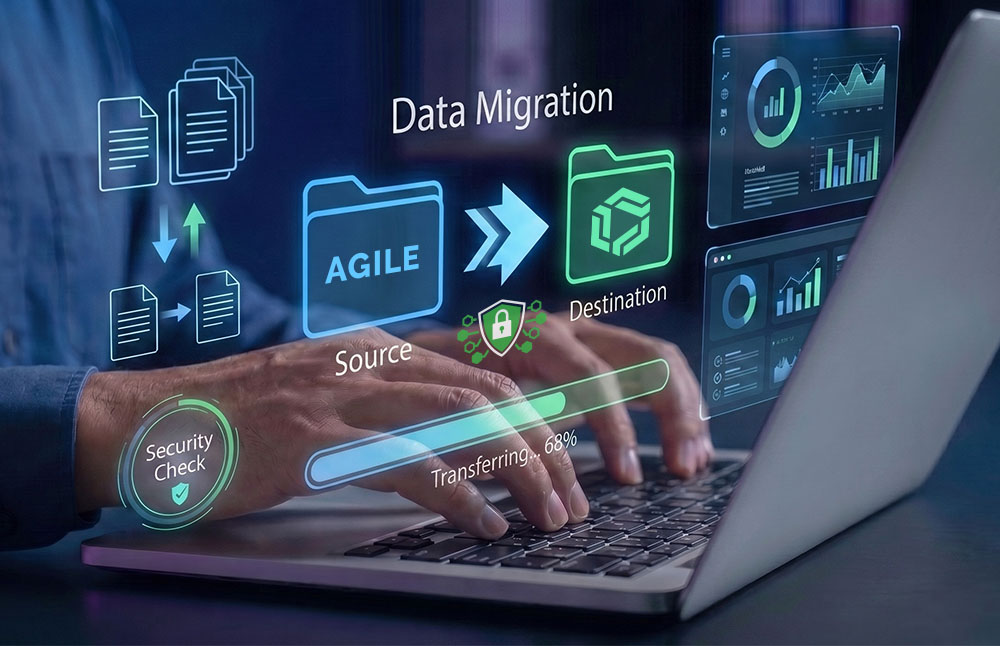
As Oracle Agile PLM approaches end of life, many manufacturers are evaluating their next product lifecycle management (PLM) platform and planning how to transition with minimal disruption. While migrating to a new system can seem daunting, the implementation often has a greater impact on success than the technology itself. Organizations that take a phased approach to migration can reduce risk, maintain business continuity, and drive faster user adoption. In this blog, we explore why a phased PLM migration delivers better results and share practical strategies for moving from Agile PLM to Arena with confidence.
Why You Need an Agile PLM Migration Strategy Now
By December 2027, Oracle will end Premier support for Agile PLM. As noted in the webinar “Not Just Migration: The Measurable Gains of Moving From Agile to Arena,” organizations still on Agile PLM will no longer receive security fixes, operating system and database certifications, browser compatibility updates, or product enhancements. Because PLM evaluations, selection processes, and implementations often take eight to sixteen months or longer, organizations need a clear migration strategy.
Why Phased PLM Adoption Outperforms an All-at-Once Rollout
Traditional “big bang” rollouts, in which every feature is launched at once, often lead to organizational shock. A phased approach is essential for long-term success. By breaking the implementation into manageable stages, organizations can ensure that their teams are not overwhelmed by learning an entirely new system. This methodical strategy allows companies to maintain business continuity while gradually introducing more advanced functionalities.
Key Steps for a Successful PLM Transition
1. Establish a Stable Foundation
Successful implementations begin with core product information and change management workflows. Joshua Lindquist, Document Control Specialist at Xirgo, emphasized this strategy: “First, stabilize your core processes and data, make sure you’re happy with it and comfortable with it. And then intentionally expand into different capabilities over time.” By focusing initially on essential engineering change order (ECO) processes and ensuring data quality, organizations can accelerate user productivity and build trust in the new system. Once the baseline is established, they can shift toward scaling more teams, locations, and external partners.
2. Recreate Familiar Processes
To reduce friction during the transition, it is vital to recreate familiar workflows in the new system. Lindquist shared that Xirgo Holdings focused on maintaining established request and approval flows to keep engineers productive immediately after migration. Rather than introducing widespread process changes alongside a new system, preserving established workflows minimizes disruption and accelerates time to value. These processes can evolve gradually as the team becomes more comfortable with the platform.
3. Align Change Management With Organizational Readiness
Adoption varies across departments. Douglas Johnston, Quality Systems Engineer Lead at Siemens Healthineers, noted that while corporate teams may quickly adopt new analytics and features they have long wanted, operational site adoption requires a larger “lift and shift” effort in the second half of implementation. Recognizing these varying levels of readiness allows project managers to allocate training resources effectively and prepare for the heavier lifting required when rolling out the system to field and operational sites.
What are Some Strategies to Reduce Disruption During a PLM Implementation?
- Engage IT Early: Involve IT within the first 30 days to grant access to data extraction tools. Scott Moisan, Senior Solution Architect at Arena by PTC, recommends using a recently refreshed test environment to protect the production system while enabling teams to extract metadata and physical files as soon as possible.
- Confirm Data Integrity: Use a sandbox environment to review, test, and validate the migrated data. A replica of the Agile configuration enables teams to explore the data, verify business processes, and finalize the migration with confidence.
- Use In-Product Guidance: Leverage embedded training resources to help occasional users navigate the system more easily. Joshua Lindquist noted that available coaches and help tools during Xirgo’s migration from Agile to Arena accelerated learning across teams and enabled users to manage the system more independently.
- Retain Critical Design History: Decide early whether your migration will include full product history or only the latest release. Both approaches are supported, and each carries different timeline and resource considerations. Full historical workspaces give engineers access to the information they need to understand design evolution, investigate past decisions, and resolve future issues more efficiently.
Why Arena Is the Best Replacement for Agile PLM
Arena is designed to be the best comparable replacement for Agile. It mirrors Agile’s classes and subclasses (categories) and supports a “lift and shift” of item and document numbering schemes, as well as the mapping of custom attributes. Johnston highlighted that Arena was the only system capable of fulfilling a rigorous list of 250+ functionalities that Agile users have come to expect, which grew to nearly double during the evaluation process. Furthermore, Arena accomplishes this on a single platform with full continuity of relationships across all affected objects.
How Arena Is an Upgrade From Agile
Companies transitioning from Agile to Arena can retain familiar processes and take advantage of modern enhancements. These include:
- Advanced BOM management
- Embedded analytics with out-of-the-box charts and dashboards
- An intuitive interface that requires less administrative overhead
- Supply chain intelligence capabilities
- AI-enabled features
Move From Agile PLM to Modern Processes
Moving away from a sunsetting system like Agile is an opportunity to modernize. By taking a phased approach and stabilizing core processes before expanding, companies can achieve faster time to value and greater innovation. A modern, cloud-native PLM solution like Arena eliminates the pain points of legacy on-premises software, including limited BOM capabilities, disconnected quality workflows, rigid integrations, and heavy IT maintenance. Watch the on-demand webinar for practical guidance on migrating from Agile PLM with minimal disruption and achieving measurable gains with Arena.
Frequently Asked Questions
What happens if you continue using Oracle Agile PLM after support ends?
Organizations that continue to use Oracle Agile PLM after support ends risk increased security, compliance, compatibility, and maintenance issues. Without ongoing vendor support, businesses are responsible for managing system issues, future technology changes, and potential integration challenges on their own.
What are the most common challenges during a PLM migration?
Common challenges include poor data quality, inconsistent business processes, limited internal resources, user adoption concerns, complex customizations, and integration dependencies. Early planning can help organizations address these challenges before migration begins.
What is the difference between legacy PLM and modern cloud PLM?
Legacy PLM systems are often deployed on-premises and require significant IT resources for maintenance and upgrades. Modern cloud PLM solutions are designed for easier administration, faster updates, greater scalability, and improved accessibility for distributed teams.
 Arena Marketing